

近日,东北大学冶金学院能源与环境材料研究中心(E2MC)Ali R. Kamali教授团队在锂离子电池高性能硅基负极材料制备领域取得重要进展,相关成果“Sustainable Terephthalic Acid Modified Polyimide Binder for Enhanced Li-Ion Storage in Silicon Nanoparticles”在期刊《Small》发表,并被选为当期封面。东北大学为第一完成单位,Ali R. Kamali教授为通讯作者。
该团队开发了一种对苯二甲酸改性聚酰亚胺粘结剂,应用于硅基负极材料。该粘结剂显著提升了电极结构完整性和反应动力学性能,从而有效提高了容量、循环稳定性以及全电池性能,为下一代高能量密度锂离子电池的发展提供了新路径。
锂离子电池是目前便携式电子设备和电动汽车领域的主导储能技术。然而,其能量密度、循环稳定性和可持续性仍面临重大挑战。硅因其极高的理论比容量(约4200 mAh g⁻¹),远高于传统石墨材料,被认为是最具潜力的负极材料之一。但在充放电循环过程中,硅材料会发生剧烈体积膨胀,导致结构严重退化,从而引发电极不稳定和容量快速衰减等问题。
针对上述挑战,研究团队采用一种简单、绿色且可规模化的原位热化学方法,开发了一种新型对苯二甲酸改性聚酰亚胺(TM-PI)粘结剂。该方法可在电极制备过程中直接对商业粘结剂进行改性,无需复杂合成工艺,降低成本并减少环境影响。
对苯二甲酸引入聚酰亚胺结构后,实现了:与硅纳米颗粒更强的界面结合力、更优的机械柔韧性以适应体积变化、更好的电解液润湿性和离子传输能力。
这些优势共同作用,有效稳定了电极结构,并显著提升了电化学性能。
所制备的硅基电极(Si@TM-PI)表现出优异性能,包括:在100次循环后仍保持2162 mAh g⁻¹的高可逆容量、约99.0%的高库伦效率、显著降低的电荷转移阻抗(12.5 Ω,远低于未改性电极的214.6 Ω)、优异的长期稳定性,在全电池体系中循环400次后容量保持率超过86%。
该研究为提升硅基负极性能提供了一条简便且具有成本效益的路径,无需依赖复杂材料或高能耗工艺。通过兼顾简易性、可规模化和高性能,该粘结剂体系为实现可持续高能量密度锂离子电池迈出了重要一步。
《Small》由Wiley-VCH出版,是纳米科学与纳米技术领域的重要国际期刊。论文入选封面文章,充分体现了该研究在创新性和科学价值方面的重要意义。
论文链接:
https://onlinelibrary.wiley.com/doi/10.1002/smll.72900?af=R
课题组网站:
http://faculty.neu.edu.cn/ali/en/more/6800/jsjjgd/index.htm
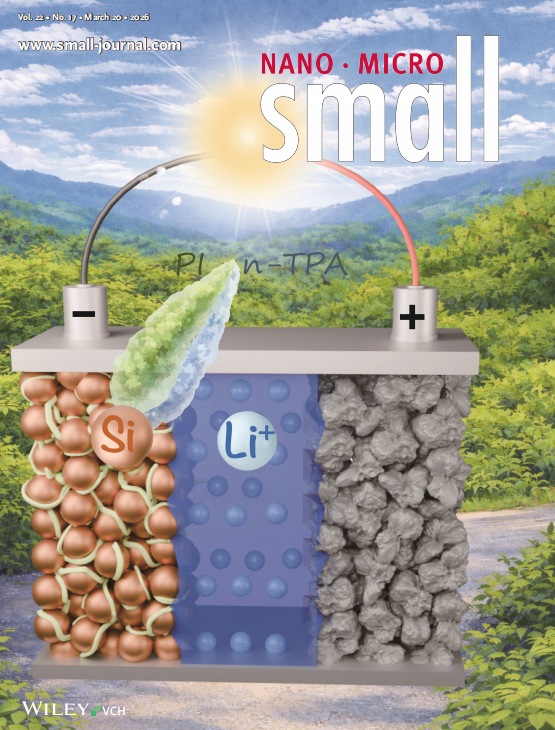
Research by Professor Ali R. Kamali’s Group Featured on the Cover of Small
Recently, Small featured on its front cover the latest research from the Energy and Environmental Materials Research Centre (E2MC), the research group led by Professor Ali R. Kamali at the School of Metallurgy, Northeastern University.
The paper, titled “Sustainable Terephthalic Acid Modified Polyimide Binder for Enhanced Li-Ion Storage in Silicon Nanoparticles,” presents a simple, green and scalable strategy for achieving high-performance lithium-ion batteries (LIBs) using silicon-based anodes.
This study introduces a green and scalable approach for developing a terephthalic acid-modified polyimide binder for silicon anodes. The binder significantly improves electrode integrity and reaction kinetics, resulting in enhanced capacity, cycling stability and full-cell performance for next-generation LIBs.
LIBs are the leading energy storage technology for portable electronics and electric vehicles. However, improving their energy density, cycling stability and sustainability remains a major challenge.
Silicon is considered one of the most promising anode materials due to its exceptionally high theoretical capacity (≈4200 mAh g⁻¹), far exceeding that of conventional graphite. Despite this advantage, silicon suffers from severe structural degradation during repeated charge-discharge cycles, caused by large volume expansion, which leads to electrode instability and rapid capacity fading.
To address this issue, the research team developed a novel terephthalic acid-modified polyimide (TM-PI) binder using a simple, green and scalable in situ thermochemical approach. This method enables direct modification of commercially available binders during electrode fabrication, eliminating the need for complex synthesis processes while reducing cost and environmental impact.
The incorporation of terephthalic acid into the polyimide structure results in:
Stronger interfacial adhesion with silicon nanoparticles
Improved mechanical flexibility to accommodate volume changes
Enhanced electrolyte wettability and ion transport
These features collectively stabilize the electrode structure and significantly enhance electrochemical performance.
The resulting silicon-based electrode (Si@TM-PI) demonstrates excellent performance, including:
A high reversible capacity of 2162 mAh g⁻¹ after 100 cycles
High coulombic efficiency of approximately 99.0%
Significantly reduced charge-transfer resistance (12.5 Ω compared to 214.6 Ω in unmodified electrode)
Strong long-term stability, retaining >86% of capacity after 400 cycles in full-cell configuration
This work provides a practical and cost-effective pathway for improving silicon anodes without relying on complex materials or energy-intensive processes. By combining simplicity, scalability, and high performance, the proposed binder system represents an important step toward sustainable, high-energy-density LIBs.
Small is a leading international journal in nanoscience and nanotechnology published by Wiley-VCH. Being selected as a front cover article highlights the novelty, scientific significance and visual impact of this research.
Article link: https://onlinelibrary.wiley.com/doi/10.1002/smll.72900?af=R
Lab Website: http://faculty.neu.edu.cn/ali/en/more/6800/jsjjgd/index.htm

